

Paris Fashion Week 2026: key dates, best areas for pop-ups and what brands should plan early
Paris Fashion Week 2026 remains one of the most competitive moments of the year for brands looking to gain physical visibility in one of the world’s most influential fashion capitals. For many international brands, knowing the official calendar is only the starting point. The real challenge often begins much earlier, when premium temporary spaces start disappearing and location becomes a strategic decision rather than a logistical one.
If you are searching for Paris Fashion Week 2026 dates, the four key periods to watch are January, March, June and late September to early October. For brands planning a pop-up store, showroom or private activation, the key question is not only when Paris Fashion Week happens, but which session matters most for your objective and how early you need to move.
Paris Fashion Week takes place across four major seasonal editions each year under the calendar published by the Fédération de la Haute Couture et de la Mode. Menswear and womenswear sessions shape the main visibility windows that brands usually monitor first.
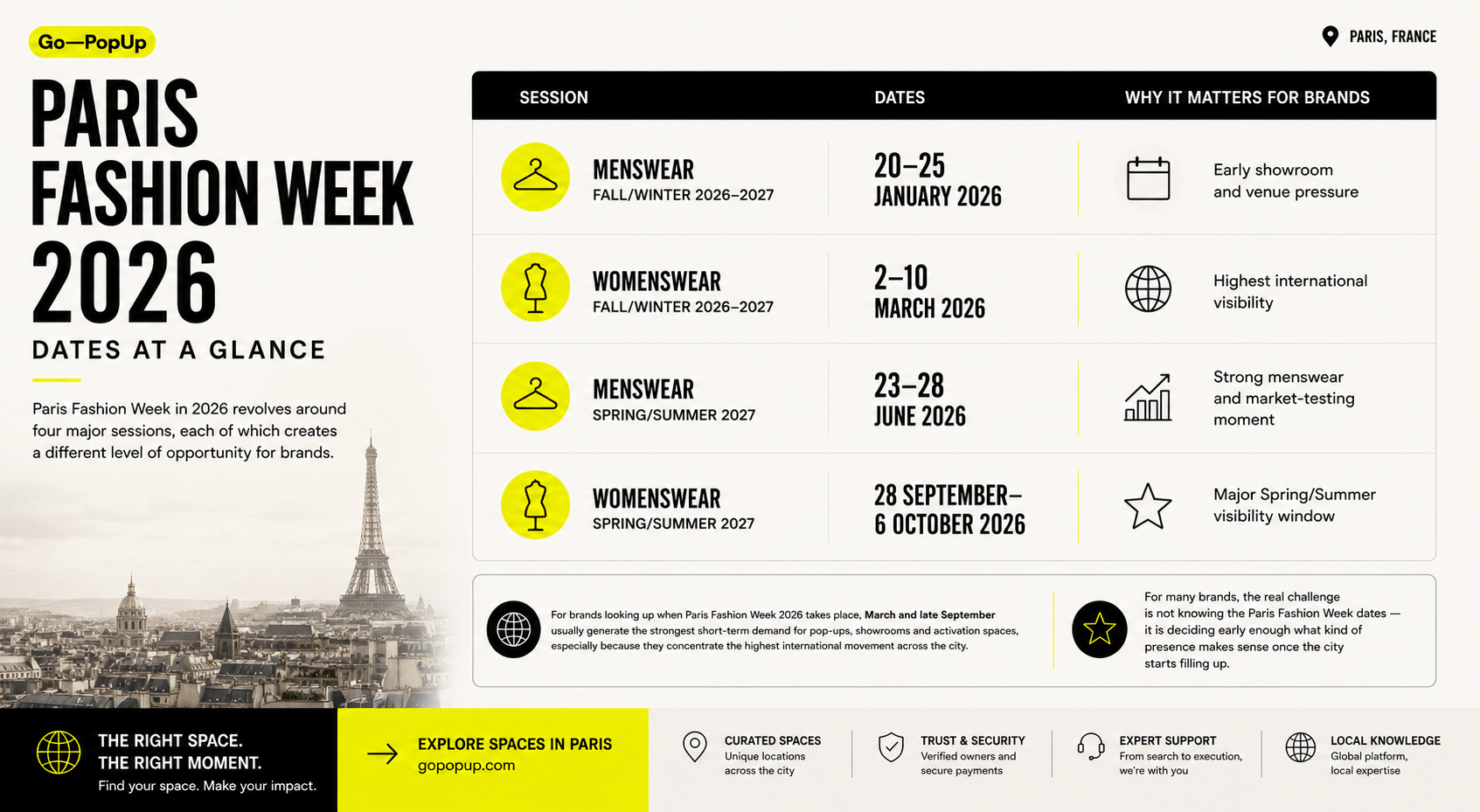
Paris Fashion Week 2026 dates at a glance
Paris Fashion Week in 2026 revolves around four major sessions, each of which creates a different level of opportunity for brands.
| Session | Dates | Why it matters for brands |
| Menswear Fall/Winter 2026–2027 | 20–25 January 2026 | Early showroom and venue pressure |
| Womenswear Fall/Winter 2026–2027 | 2–10 March 2026 | Highest international visibility |
| Menswear Spring/Summer 2027 | 23–28 June 2026 | Strong menswear and market-testing moment |
| Womenswear Spring/Summer 2027 | 28 September–6 October 2026 | Major Spring/Summer visibility window |
For brands looking up when Paris Fashion Week 2026 takes place, March and late September usually generate the strongest short-term demand for pop-ups, showrooms and activation spaces, especially because they concentrate the highest international movement across the city.
For many brands, the real challenge is not knowing the Paris Fashion Week dates — it is deciding early enough what kind of presence makes sense once the city starts filling up.
Why Paris Fashion Week matters for brands beyond the official calendar
Paris Fashion Week is not only a runway calendar. It is one of the few moments when buyers, press, creative partners and fashion audiences concentrate physically in the city at scale.
That changes the role of temporary retail.
A well-positioned activation during Paris Fashion Week can support very different objectives: creating visibility, hosting private appointments, testing a market or building relevance in a city that already acts as a global filter for fashion credibility.
This is why many brands approach Paris not simply as an event destination, but as a short-term retail opportunity. The official calendar matters, but the business opportunity around it often starts earlier.

Which Paris Fashion Week session is most relevant for your brand?
Not every Paris Fashion Week session creates the same type of opportunity. The strongest choice depends on whether your brand is looking for visibility, wholesale conversations, private meetings or market testing.
January: menswear and early luxury momentum
January usually attracts brands linked to menswear, accessories and premium positioning. It tends to work especially well for showroom-led formats, curated appointments and smaller activations where selectivity matters more than public footfall.
For brands that do not need mass visibility but still want to be present in the right conversations, January can be a strong strategic window. The atmosphere is often more controlled, which benefits brands that rely on product presentation, wholesale conversations or relationship-building rather than spontaneous walk-in traffic.
It can also be a useful entry point for brands that want to test Paris in a more measured way before the more competitive periods later in the year.
March: the strongest visibility window
For many brands, March remains the most strategic Paris Fashion Week session.
The womenswear calendar creates one of the highest levels of international attention in the city, which usually translates into stronger retail pressure, more parallel activations and higher demand for premium short-term spaces.
For brands seeking public visibility, this is often the moment when a well-positioned pop-up can generate the strongest impact. The city feels more saturated, but that same intensity can work in favour of brands that need exposure, discovery and cultural relevance during a high-attention period.
It is usually the best fit for brands that want to combine physical presence with media momentum, audience interaction and a stronger sense of visibility around a launch or a brand statement.
June: a different profile for menswear-led activations
June can be a more flexible entry point for menswear-focused brands or categories that benefit from a slightly less saturated environment.
The city still concentrates attention, but often with a different rhythm than March. For some brands, this creates a more manageable context for testing formats, audiences or positioning.
This session can be especially useful for brands that want to enter Paris without competing at the highest pressure point of the year. It often allows for more control over the format, a calmer planning process and a setting that may feel more suitable for niche audiences or more focused commercial objectives.
For menswear-led concepts, June can offer a better balance between relevance and operational flexibility.
September / October: Spring/Summer visibility and launch momentum
The late September edition is especially attractive for brands launching new narratives before year-end. It combines strong international visibility with a city already primed for discovery.
For brands that want presence, energy and strong timing around new collection storytelling, this is often one of the most valuable windows in the year. It tends to work well for activations that need both visibility and strategic timing, especially when the objective is to create momentum before the final commercial stretch of the year.
In practice, this period can be particularly effective for brands that want to connect a physical activation with a broader launch strategy, whether that means awareness, press attention, retail testing or a stronger positioning moment in Paris.
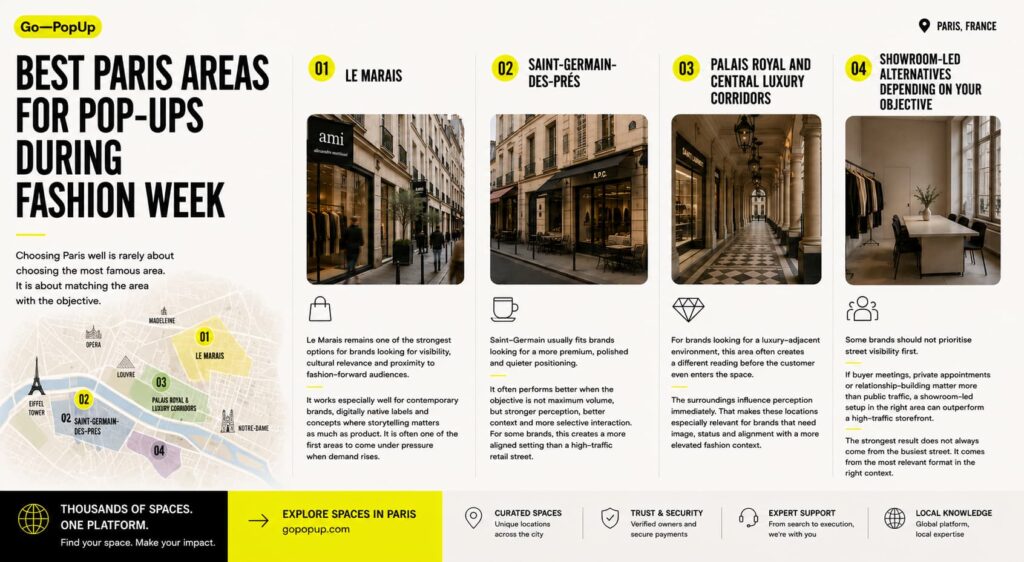
Best Paris areas for pop-ups during Fashion Week
Choosing Paris well is rarely about choosing the most famous area. It is about matching the area with the objective.
Le Marais
Le Marais remains one of the strongest options for brands looking for visibility, cultural relevance and proximity to fashion-forward audiences.
It works especially well for contemporary brands, digitally native labels and concepts where storytelling matters as much as product. It is often one of the first areas to come under pressure when demand rises.
Saint-Germain-des-Prés
Saint-Germain usually fits brands looking for a more premium, polished and quieter positioning.
It often performs better when the objective is not maximum volume, but stronger perception, better context and more selective interaction. For some brands, this creates a more aligned setting than a high-traffic retail street.
Palais Royal and central luxury corridors
For brands looking for a luxury-adjacent environment, this area often creates a different reading before the customer even enters the space.
The surroundings influence perception immediately. That makes these locations especially relevant for brands that need image, status and alignment with a more elevated fashion context.
Showroom-led alternatives depending on your objective
Some brands should not prioritise street visibility first.
If buyer meetings, private appointments or relationship-building matter more than public traffic, a showroom-led setup in the right area can outperform a high-traffic storefront. The strongest result does not always come from the busiest street. It comes from the most relevant format in the right context.
Explore Paris spaces for Fashion Week activations
If you are already moving from planning to execution, comparing real spaces early usually makes more sense than waiting until the official calendar gets closer.
Suggested collections:

Where to rent a pop-up space in Paris during Fashion Week
Once the right area is clear, the next step is not looking at Paris in general, but comparing the type of space that actually fits the activation.
During Paris Fashion Week, brands usually evaluate very different options depending on their objective. Some need a street-level pop-up store with visibility and walk-in potential. Others need a more private showroom setting for appointments, buyers or press meetings. In other cases, the priority is a flexible event venue that can support a branded activation, a launch or a more curated experience.
This is why the search should not begin with availability alone. It should begin with the format, the neighbourhood and the type of audience the brand wants to reach.
For most brands, the most useful approach is to compare:
- pop-up stores in central high-traffic areas
- showrooms in more selective neighbourhoods
- event spaces that allow a more flexible branded setup
If you are planning a Paris Fashion Week activation, reviewing real space options early usually creates a better outcome than waiting until the market is already under pressure.
Popup store, showroom or private activation: what format fits your objective?
The best format depends less on trend and more on what the brand actually wants to achieve.
| Brand objective | Best format |
| Public visibility | Pop-up store |
| Buyer meetings | Showroom |
| Press appointments | Private activation |
| Market testing | Flexible short-term retail |
A common mistake is choosing the format after choosing the city. In practice, the format often determines which Paris area makes sense, what type of venue is useful and how the activation should be planned.
A pop-up store is typically the strongest format for public exposure, consumer interaction and direct brand visibility.
A showroom is usually more effective for appointments, wholesale conversations, press previews and controlled interactions.
A private activation can work better when exclusivity, invitation-only experiences or relationship-building are more important than public traffic.
How early should brands secure a space for Paris Fashion Week 2026?
Brands often underestimate how early the strongest options begin to disappear.
The most strategic spaces are usually not selected once official schedules feel close. They are secured once brands define objective, budget, activation format and preferred neighbourhood.
This is particularly true for March and September, when availability narrows faster in the strongest retail zones.
As a general rule, premium spaces can start being secured three to six months in advance, and in some cases even earlier for the most in-demand areas. Waiting too long usually means reduced choice, higher pricing pressure and compromises on location, visibility or format.
How much does a pop-up space in Paris cost during Fashion Week?
There is no single price for a pop-up space in Paris during Fashion Week, because cost depends on much more than location alone.
In practice, pricing is usually shaped by a combination of factors:
- neighbourhood and street visibility
- size of the space
- ground-floor retail exposure or showroom setup
- duration of the booking
- timing within the Fashion Week calendar
- technical requirements, production needs or installation constraints
A small showroom in a selective area may be more accessible than a street-level retail space in a prime location such as Le Marais. At the same time, a short activation during a peak week can generate more pricing pressure than a longer booking outside the strongest demand window.
For brands, the key is not asking only how much a space costs, but what type of presence the budget needs to support.
In many cases, the real budget should consider:
- venue cost
- local production or light adaptation
- logistics and installation
- permits or technical requirements when needed
- operational coordination during the activation
This is why brands usually make better decisions when they define budget together with objective, area and format, rather than treating the venue as an isolated cost.
What brands often underestimate when planning Paris Fashion Week
The most common mistake is thinking first about being present, and only later about why.
That usually creates weak activations.
The stronger approach is to define first:
- whether the goal is visibility or intimacy
- whether the format should be public or appointment-led
- whether the brand wants short-term impact or market testing
- whether the activation is meant to generate awareness, sales, press relevance or B2B relationships
Only then does the space become strategically useful.
Why local execution matters more than many brands expect
A successful Paris activation rarely depends on finding a venue alone.
In practice, what often shapes the result is everything that follows: production timing, technical constraints, local coordination, deliveries, permits and installation windows.
For international brands, this is usually where planning becomes more complex than expected. A space may look right on paper, but the operational reality often determines whether the activation truly works.
This is one of the main reasons why planning early matters. It gives brands more room not only to choose the right venue, but also to execute the project properly once the city reaches peak demand.
Planning Paris Fashion Week 2026 starts well before the official calendar
The activations that work best in Paris rarely depend on the venue alone; they are usually supported by a clear decision around timing, format and local execution.
For many brands, the most useful step at this stage is not waiting for the final calendar, but starting to compare real options and understanding which part of Paris best fits the project.
If you are exploring possible spaces, you can start by reviewing these collections:
Visit our marketplace for event spaces in Paris
And if the project requires more than simply finding a venue — for example local coordination, production or activation support — it is usually worth planning this from the beginning to avoid limitations once the city reaches peak demand.
FAQ: Paris Fashion Week 2026 for brands
When is Paris Fashion Week 2026?
Paris Fashion Week 2026 is structured around four main seasonal windows: January, March, June and late September/early October.
Each of these sessions corresponds to specific segments of the industry (menswear or womenswear) and different seasonal collections (Fall/Winter or Spring/Summer).
For brands, this means the calendar is not a single event but a sequence of opportunities throughout the year, each with a different level of international attention, buyer presence and media impact.
The most relevant dates typically align with:
- March (Womenswear Fall/Winter) → peak global visibility
- Late September (Womenswear Spring/Summer) → strong launch momentum before year-end
Understanding this structure is key to deciding not only when to be present, but what role your activation should play within that specific moment.
Which Paris Fashion Week session is best for a pop-up?
There is no single “best” session — it depends entirely on your objective.
- March and September usually offer the highest footfall, press exposure and international audience, making them ideal for visibility-driven pop-ups and brand awareness campaigns.
- January and June tend to be more selective, with a stronger focus on industry professionals, which makes them more suitable for showrooms, private appointments or B2B interactions.
Brands that prioritise sales and public engagement typically perform better during high-traffic periods, while brands focused on wholesale, partnerships or positioning often benefit from quieter but more targeted sessions.
The key is aligning the session with the type of interaction you want to generate — not simply choosing the busiest moment.
How early should brands plan a Paris Fashion Week activation?
Most brands underestimate how early planning needs to start.
For high-demand periods like March and September:
- Premium spaces can start being secured 3 to 6 months in advance
- The best locations (Le Marais, Saint-Germain, central areas) are often taken even earlier
Waiting until the official calendar feels “close” usually means:
- Limited availability
- Higher prices
- Compromises on location or format
The optimal approach is to define early:
- Objective (visibility vs meetings)
- Budget
- Format (pop-up, showroom, activation)
- Preferred area
Once these are clear, securing the space becomes a strategic decision rather than a reactive one.
Is a showroom better than a pop-up during Paris Fashion Week?
Neither is better — they serve completely different purposes.
- A pop-up store is designed for:
- Public visibility
- Brand awareness
- Direct interaction with consumers
- Sales and footfall
- A showroom is more effective for:
- Buyer meetings
- Press previews
- Private appointments
- Relationship building
In many cases, the mistake is choosing the format based on trend rather than objective.
Brands that need controlled interactions and qualified conversations often perform better with a showroom, even if it has lower visibility.
Brands that want impact, exposure and discovery should prioritise a pop-up in a high-traffic area.
The format should always be defined first — because it directly determines the type of space and location that makes sense.
Useful References & Further Reading
If you want to explore more about Paris Fashion Week and the global fashion calendar, here are some official and trusted resources:
- Official website of the Fédération de la Haute Couture et de la Mode (FHCM):
https://www.fhcm.paris/en/paris-fashion-week - Full overview and historical context of Paris Fashion Week:
https://en.wikipedia.org/wiki/Paris_Fashion_Week - Official Paris Fashion Week calendar (dates, designers, events):
https://www.fhcm.paris/en/paris-fashion-week/calendar